Production got cheap.
Ad creative, landing pages, content. AI produces the variants. We own the thinking that comes before them.












AI ships a hundred variants in an afternoon. They're all fine, but fine is the new failure mode.
What ships fast looks interchangeable. What ranks today fades tomorrow. What gets generated for AI engines reads like it was generated for AI engines.
The real work moved upstream: into the brief that decides what's worth making, the page that answers the question people are actually asking, the content that earns its citation instead of chasing a ranking.
That work doesn't ship in an afternoon.
The asset got cheap. Mattering didn't.
SEO, CRO and creative, from the impression to the conversion.
Creatives
A hundred variants by lunch is table stakes now. The variants aren’t the work. The work is the brief that decides what gets tested, the grid that isolates what performs, and the discipline to scale only what stood out.
Creative testing grids, over one-off ads.
One-off ads teach you nothing you can reuse. We lay the work out as a grid instead: strategic themes down one axis, narrative angles across the other, a distinct test in every cell. The Dragonfly framework reads the results, so we know which angle carried a winner and which one just rode a good offer. The angle gets scaled, not the ad.
Design systems, to scale creative variations.
Volume is where most brands come apart: forty formats across six languages, each one drifting a little further from the last. We build the brand as a design system first, then generate the variations and HTML5 assets from it. Type, spacing and logo rules are decided once and inherited everywhere, so the fiftieth banner still looks like the first and testing never waits on production.
Dynamic Creative Optimisation via DV360.
Where the media plan justifies it, we run full Dynamic Creative Optimization inside Display & Video 360. A live feed drives the creative: price, availability, location, weather, whatever actually changes the message. One template covers what would otherwise be forty hand-built assets, and because the feed drives each element, you can see which element won rather than which ad did.
Landing pages
The ad makes a promise. The page keeps it or loses the click. Most paid traffic still lands on a page built for everyone, calibrated for no-one. Pair the campaign’s question with the page that answers it.
Funnel analysis, where the page loses people.
Before we redesign anything, we map where visitors drop off. Funnel analysis in GA4 and BigQuery, session replays and heatmaps, and the on-page signals that reveal hesitation. The output is a prioritized friction map, not a hunch, so every change answers a problem we can actually see.
Conversion rate optimisation through UX and UI.
We audit the pages your paid traffic already lands on and fix what costs conversions: the form that asks too early, the hierarchy that buries the offer, the mobile layout nobody checked. Then we hand over templates your team deploys without us. The next campaign gets a page built for its question, not the homepage with a new headline.
A/B testing the big swings, not button colors.
Frictions become scored hypotheses, and we test the changes big enough to move a number. At real traffic levels that means testing high-intent micro-conversions, reading significance with guardrails, and logging every result so wins compound instead of resetting each quarter.
Organic visibility
SEO didn’t disappear when AI arrived. The content side got faster and noisier. AI ships a hundred pages by Friday, and most of them rank for nothing. The structural side didn’t change. Pages still earn visibility through topic depth, technical hygiene, and signals that aren’t easy to fake. The work runs in twelve-month cycles, not ninety-day sprints.
SEO content that earns the citation.
Transactional queries get landing pages, categories get pillar pages, and the questions buyers actually ask get evergreen articles written to be cited by Google's AI Overviews and the other engines pulling from the open web. We publish in whichever languages the market speaks. Most of the productised hours sit here, because content is where the equity accumulates.
Technical SEO and earned signals.
Schema, canonicals, GA4 tracking and site structure get set once and audited twice a year, because what breaks a site is usually drift rather than a decision. Beyond Google's index, AI engines corroborate what they find against long-form on LinkedIn, third-party review platforms and trust databases, so those are maintained too. We clean up toxic links. We do not run outbound link campaigns and we do not sell backlinks.
Rank tracking, and what positions are worth.
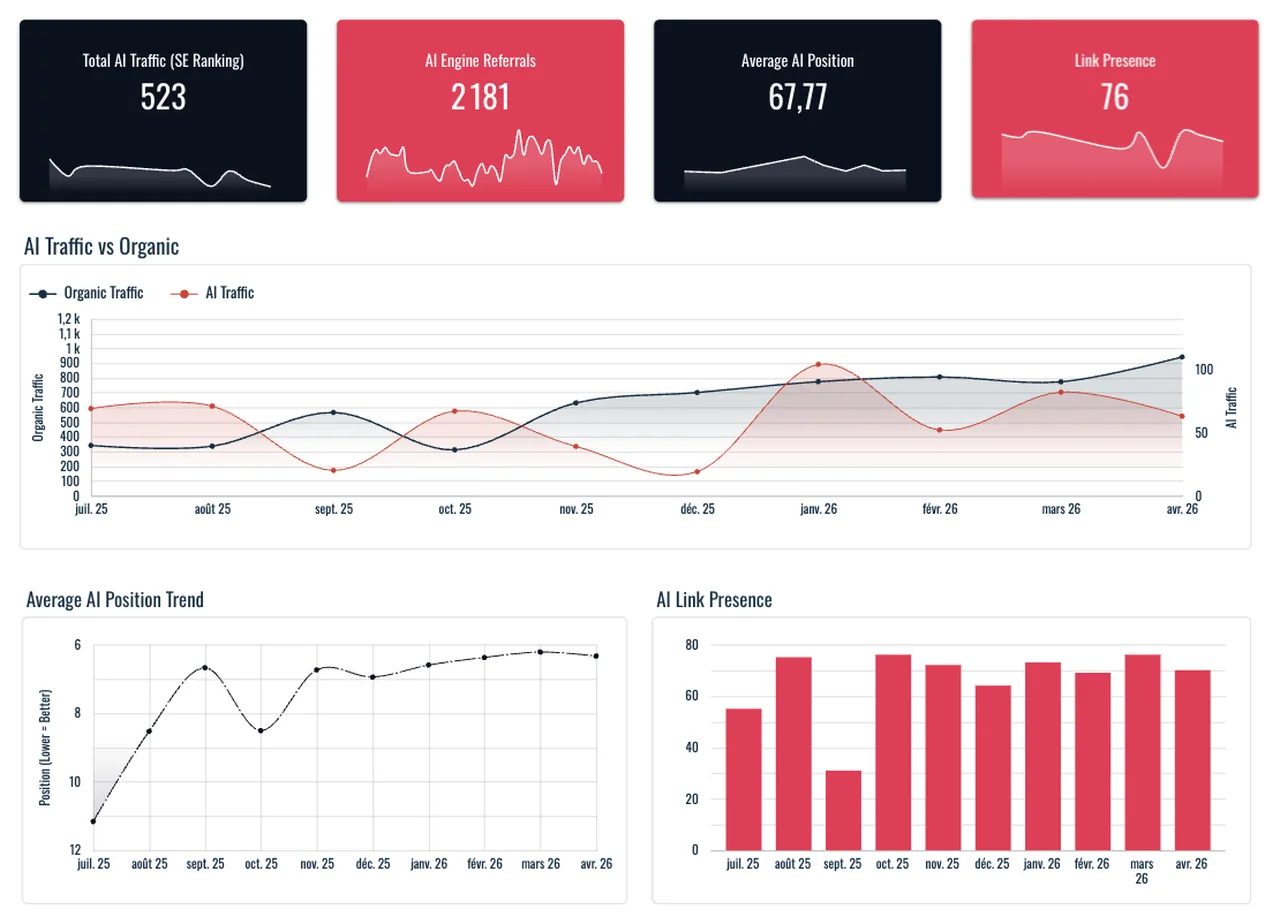
The dashboard goes up in month one, so there is a baseline before anything changes. It tracks position and visibility by market and by query cluster, which pages are gaining or losing ground, and where citations are appearing in AI answers. We review it monthly and rebalance quarterly, moving effort toward the clusters that are actually moving.
Output got faster.
The brief got harder.
Once the thinking is in place, the production stops looking generic.
Creative, conversion, visibility. Each its own shape.
Start with a conversation. We scope from there. If measurement needs to come first, we'll say so.